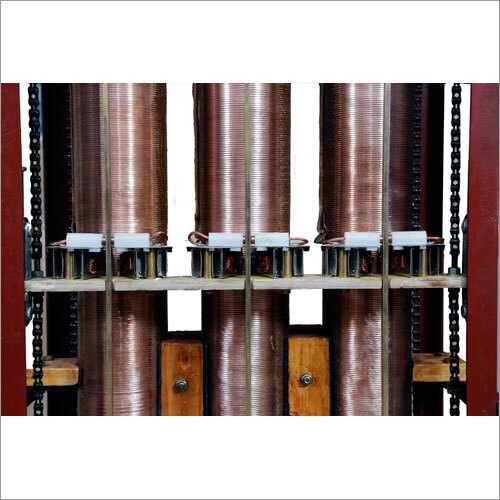
Automatic Voltage Regulator offered by us has been designed by qualified technocrats of our organization. Application of this equipment can be noticed in power transmission unit of commercial and residential buildings to control voltage supply in electrical circuit. State of the art technical knowledge has been applied to design such regulator. Quality of this Automatic Voltage Regulator has been determined on the basis of thorough testing procedure before its dispatch to customer. This product can be accessed in different specifications and at competitive price range.
Features
- Ability to work under high voltage condition
- Standard surface finish
- Good thermal attributes
Further Details:
Inner View of Regulator
WHO NEEDS A STABILIZER:
The industrial units having abnormally higher failure rate of Electrical Equipments such as bulbs, tubes, chokes, starter, contactor coils & motors (particularly smaller capacity motors upto 7.5 H.P.) Etc. Should verify that it may be due to HIGHER voltage. You may note down Hourly readings of voltage variation for few days. If you find that input voltage is above 230 volts single phase/400 volts Three phase even for few hours a day, then you definitely require a stabilizer.
HOW TO ACCESS HIGHER LOSSES & LOW POWER FACTOR IN INDUSTRIAL UNITS WITHOUT INSTALLING STABILIZER:
Note down hourly readings of current and voltage of one motor operating at constant load for 2-3 days. From the different readings you will observe that the current drawn by the motor is minimum at 390/400 volts as compared to the current drawn at other voltages. This means that power consumed by the motor is minimum at 390/400 volts.
Also note down hourly readings of voltage and K.W. from your Electronic Energy Meter for 2-3 days. From the readings you will observe that K.W. is minimum at 390/400 volts in most of the readings as compared to the higher voltage.
If you find that the above collected details are true then you will certainly have the advantages after installing the Servo stabilizer as mentioned on succeeding page 3
ADVANTAGES:
- Reduction in Breakdown of Electrical Equipments
- Energy Saving
- Improvement in Power Factor
- Reduction in MDI
- Uniform Quality of End Product
- 80% Depreciation as per Income Tax Act
The table below gives approximate quantitative advantages of Automatic Voltage Controller at various fluctuation levels:
Input Voltage Variation | Appx.% reduction In Breakdown of Appx. Power Saving Possible Electrical equipments |
| Motor Load Below 10 hp | Lighting Load | Motor Load Below 10 hp | Lighting Load |
380-400 Volts | Nil | Nil | Nil | Nil & servo stabilizer is not required |
400 - 420 volts | 5% | 10% | 3% | 5% |
420 - 440 volts | 10% | 20% | 5% | 10% |
440 - 460 volts | 40% | 40% | 7% | 20% |
460 - 480 volts | 60% | 60% | 10% | 30% |
Precision Voltage Regulation for Sensitive EquipmentAchieve consistent voltage output for motors, appliances, computers, and laboratory instruments. The advanced servo motor control maintains accuracy within 1%, reducing the risk of equipment malfunction and enhancing longevity. Its sensitive response time ensures instant adjustment to fluctuating input voltages, safeguarding delicate and critical devices.
Durable Design Built for Demanding EnvironmentsConstructed from a robust metal enclosure and toroidal transformer, this regulator endures rigorous operating environments. Its compact form is ideal for both floor and table mounting, suitable for space-constrained industrial, commercial, and domestic settings. With an IP21 degree of protection, and operation up to 95% humidity, it offers dependable service even in challenging climates.
Safety and Protection IntegratedEquipped with overload, short circuit, surge protection, and automatic voltage cutoff, this regulator defends connected equipment from electrical hazards. The digital voltmeter provides real-time output monitoring, and quiet operation (below 55 dB) ensures minimal disruption in noise-sensitive areas, making it an ideal choice for labs and workspaces.
FAQ's of Automatic Voltage Regulator:
Q: How does the automatic voltage regulator ensure stable output for sensitive devices?
A: The regulator uses a servo motor control system, which continuously senses and adjusts the output voltage to maintain a tight 1% regulation, even when the input fluctuates between 150V and 270V AC. This rapid correction (response time below 1 second) provides a steady output of 220V/230V AC, ideal for sensitive equipment like computers and laboratory instruments.
Q: What are the main benefits of using this voltage regulator in industrial or commercial environments?
A: The main benefits include reliable voltage stabilization, comprehensive protection features (overload, short circuit, surge, and voltage cutoff), high efficiency (over 95%), and a heavy-duty design. These features minimize downtime, prevent equipment damage, and ensure smooth operations in demanding settings.
Q: Where can this voltage regulator be installed and used most effectively?
A: Thanks to its compact and robust floor/table mounting design, this voltage regulator is suitable for industrial machinery, commercial appliances, domestic devices, and laboratory equipment. Its IP21 protection and resistance to high humidity (up to 95% non-condensing) allow it to perform reliably across diverse environments.
Q: What process is involved in installing this voltage regulator?
A: Installation involves securely mounting the unit on a stable floor or table surface near the load, connecting the input and output terminals as per the instructions, and setting up the digital voltmeter display for monitoring. Ensure mains power isolation before installation and follow standard electrical safety guidelines.
Q: How does the overload and surge protection work in this device?
A: Integrated protection circuits continuously monitor output conditions. In the event of an overload, short circuit, or voltage surge, the device automatically disconnects or isolates the load, preventing potential damage to both the regulator and connected equipment.
Q: What makes the toroidal transformer and air-cooled design advantageous for this regulator?
A: Toroidal transformers offer higher efficiency, lower core losses, and reduced waveform distortion compared to conventional transformers. Combined with the air-cooled system, this design improves thermal management, extends operational life, and maintains quiet operation (less than 55 dB).